September 4, 2026 · BlueGPS Team
Pharmaceutical Cold Storage: Using RTLS to Improve Visibility, Control, and Traceability
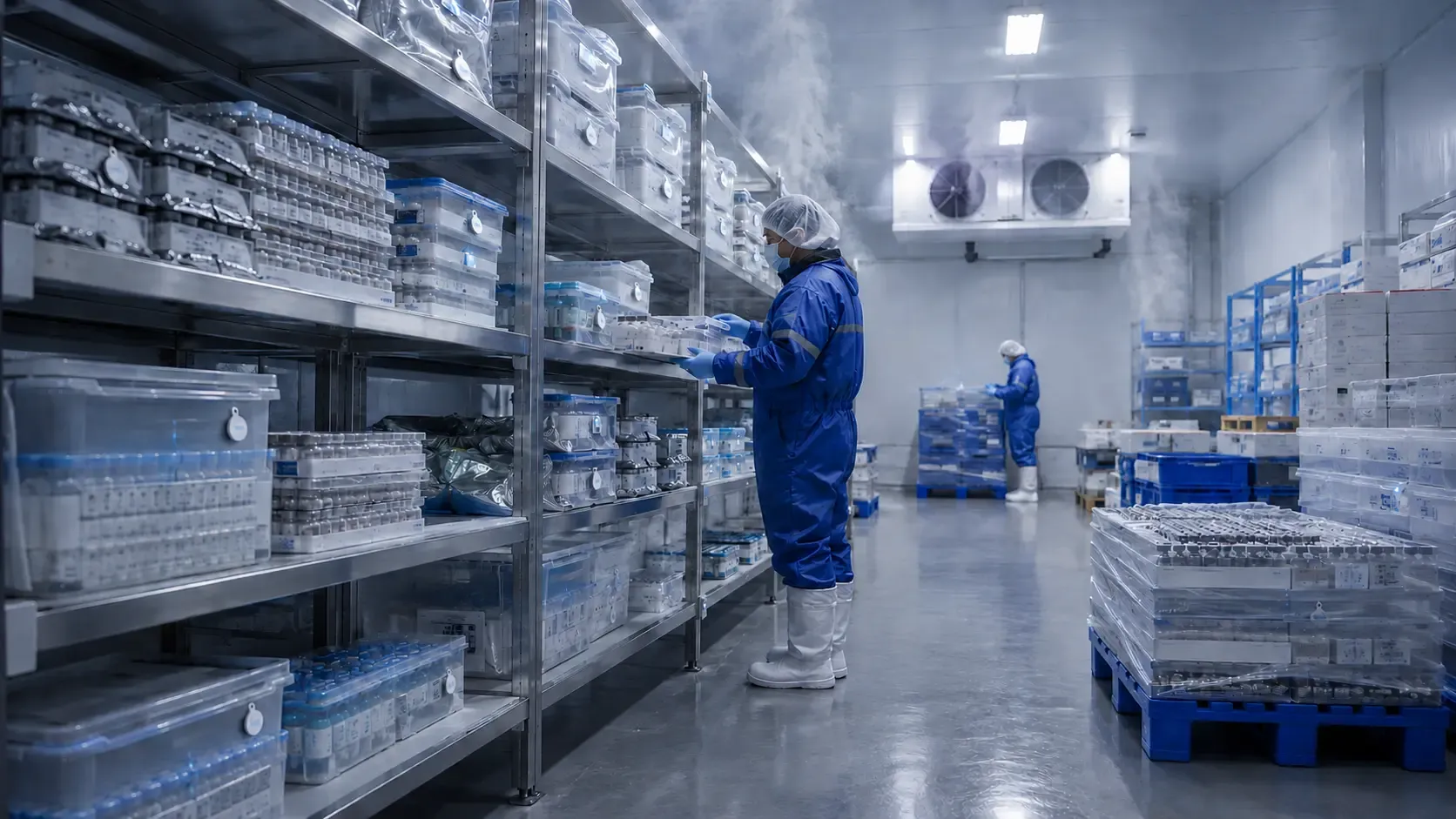
Maintaining the temperature is only one part of the pharmaceutical cold-storage problem. Manufacturers also need to know what is inside cold storage, where it is located, how long it has been there, whether it should be there, and where it went next.
Raw materials, active pharmaceutical ingredients, biological materials, intermediates, samples, vaccines, and finished products may all require storage within defined temperature ranges. Some products require refrigeration, commonly between 2°C and 8°C, while others need frozen or ultra-low-temperature conditions. The required range depends on the stability data and approved storage conditions for the specific material or product.
Maintaining the temperature is only one part of the problem. Manufacturers also need to know what is inside cold storage, where it is located, how long it has been there, whether it should be there, and where it went next.
This is where real-time location systems (RTLS) can add another layer of control.
Why pharmaceutical cold storage is difficult to manage
Pharmaceutical cold storage combines inventory management with environmental control and Good Manufacturing Practice (GMP) requirements.
In the United States, 21 CFR 211.142 requires drug products to be stored under appropriate conditions of temperature, humidity, and light so that their identity, strength, quality, and purity are not affected.
Temperature-controlled areas therefore need monitoring and qualification. The World Health Organization also identifies temperature mapping as an important part of pharmaceutical storage management. Temperature mapping establishes how conditions vary throughout a three-dimensional storage space rather than assuming that every shelf and corner remains at the same temperature.
None of this, however, automatically tells a manufacturer where a particular pallet, container, sample, or batch is located.
A temperature monitoring system might confirm that Cold Room 3 remained within its validated range. An inventory system might show that Batch A173 is assigned to Cold Room 3.
Neither necessarily confirms that Batch A173 is physically there, or where in the cold room it is located.
Temperature monitoring and RTLS solve different problems
RTLS should not replace a validated environmental monitoring system.
The two technologies answer different questions.
A temperature monitoring system answers questions such as:
- Was the cold room maintained within its specified limits?
- When did a temperature excursion begin?
- How high or low did the temperature reach?
- How long did the excursion continue?
RTLS addresses another set of questions:
- Which materials were present during the excursion?
- Where exactly were they stored?
- When did each item enter and leave?
- Which items have remained in staging longer than expected?
- Has material entered the wrong storage zone?
- Where is a specific batch, pallet, tote, sample, or piece of equipment now?
Combining these data sets can provide much more useful operational context.
Finding affected material after an excursion
Consider a refrigeration fault affecting part of a cold room.
Environmental monitoring detects the temperature excursion and generates an alarm. Quality personnel now need to determine which materials may have been exposed.
Without detailed location information, the investigation can become a manual exercise involving warehouse records, barcode scans, paper logs, operator interviews, and physical searches.
RTLS can provide a movement history showing which tracked items were present within the affected area during the relevant period.
Quality teams can then compare location records with environmental data and product stability information.
RTLS does not determine whether a pharmaceutical product remains suitable for use. That remains a quality decision based on validated procedures, stability data, temperature records, and applicable GMP controls.
What RTLS can do is reduce uncertainty about which material requires assessment.
Reducing time outside controlled storage
Cold-chain risk does not exist only inside refrigerators and freezers.
Materials frequently move through receiving areas, staging zones, production rooms, inspection points, airlocks, packing areas, and dispatch locations.
These transitions create periods when material may be outside its normal storage environment.
A barcode scan might record that material left a cold room, but it provides little information about what happened between that scan and the next recorded transaction.
RTLS can measure dwell time automatically.
For example, a rule could identify when a temperature-sensitive material leaves a defined cold-storage zone. If it remains within an uncontrolled staging area longer than the permitted process time, the system can generate an alert or create an event for another application.
This changes cold-chain management from simply recording transactions to monitoring physical flow.
Preventing storage and staging errors
Pharmaceutical facilities often contain multiple controlled areas with different purposes.
These might include:
- quarantine storage
- released-material storage
- refrigerated raw-material areas
- intermediate-product storage
- sample storage
- rejected-material areas
- dispatch staging
- freezer or ultra-low-temperature storage
An item placed in the wrong physical zone can create a quality or process problem even when the surrounding temperature remains acceptable.
Location systems can use geofences, which are virtual boundaries drawn around physical areas.
When a tracked item crosses a boundary, the RTLS platform creates an event. Rules can then compare that event with information about the material.
For example, if an item classified as quarantined enters a released-material zone, the system could flag the movement. Likewise, material assigned to refrigerated storage could trigger an alert when it remains outside the approved zone beyond a defined period.
The purpose is not simply to put dots on a digital map. It is to connect location with process rules.
Improving inventory searches inside cold rooms
Searching inside pharmaceutical cold storage also has operational consequences.
Every unnecessary door opening introduces heat and moisture. Personnel working in freezer environments may also face limits on how long they should remain inside.
When inventory records do not match physical locations, operators can spend time opening doors, checking shelves, moving containers, and searching storage positions.
RTLS provides a current or last-known location for tagged items.
Depending on the accuracy required, a system might identify the cold room containing an item, the storage zone within that room, or a more precise position.
Not every application requires centimeter-level positioning. For many cold-storage applications, confirming that an item is present within the correct room or zone may provide enough information.
That understanding can reduce both infrastructure cost and system complexity.
Creating a history of material movement
Cold storage is part of a wider material journey.
A pharmaceutical material might move from goods receipt to quarantine, cold storage, weighing, manufacturing, temporary storage, packaging, and dispatch.
Tracking those movements creates a time-based record of how material flows through the facility.
This can help manufacturers investigate:
- unexpected dwell times
- repeated staging delays
- unnecessary material movements
- congestion around cold rooms
- differences between planned and actual workflows
- assets entering unauthorized areas
- handover delays between departments
The resulting data can also support process improvement.
Instead of relying only on individual incidents, manufacturers can analyze hundreds or thousands of movements to identify patterns that would otherwise remain hidden.
Selecting RTLS technology for pharmaceutical cold storage
Cold-storage environments create technical challenges for location systems.
Metal shelving, insulated walls, machinery, dense inventory, liquids, and room construction can all affect radio-frequency propagation.
The required accuracy should therefore determine the technology rather than the other way around.
Bluetooth Low Energy (BLE) can provide a cost-effective method for room, zone, or more detailed indoor positioning. Ultra-Wideband (UWB) can support applications requiring higher positional accuracy. RFID can identify movements through defined checkpoints, while GPS or GNSS can extend tracking to outdoor logistics areas.
BlueGPS is hardware-agnostic and can combine location data from BLE, UWB, RFID, barcode systems, GPS/GNSS, and existing location infrastructure within one software platform.
This allows manufacturers to apply different technologies to different parts of the process rather than forcing every cold-chain application onto the same tracking architecture.
Turning cold storage into part of the digital manufacturing process
Pharmaceutical cold storage has traditionally been managed as a controlled environment: qualify the room, monitor the temperature, control access, and record inventory transactions.
RTLS adds another dimension: continuous evidence about physical movement.
It can show when material entered cold storage, where it was placed, when it moved, how long it remained outside a controlled area, and which process step followed.
When combined with temperature monitoring, warehouse systems, MES, ERP, and quality processes, location data can help create a more complete record of what actually happened to pharmaceutical material inside the facility.
For manufacturers, the goal is not tracking for its own sake.
It is to reduce the gap between what production systems say should be happening and what is physically happening on the factory floor.
BlueGPS brings location data from multiple RTLS technologies into one platform, allowing pharmaceutical manufacturers to create maps, zones, rules, alerts, movement histories, and integrations around their existing processes.
Discover how BlueGPS can add real-time location intelligence to pharmaceutical manufacturing.