September 4, 2026 · BlueGPS Team
Why Asset Tracking in MRO No Longer Needs to Be a Major Infrastructure Project
How to select and deploy RTLS technology for improving MRO operations without starting a major infrastructure project.
FIRST PUBLISHED ON AERO NEXTGEN: https://www.aero-nextgen.com/aero-nextgen-x-synapses-asset-tracking-without-infrastructure/
Real-time asset tracking in MRO used to require a capital project. That requirement is gone. Changes in RTLS hardware, software, and deployment models now put location intelligence within reach of regional MROs, independent maintenance facilities, component repair shops, and specialist operators, not only the large operators with dedicated engineering and IT teams. The shift is not a better sensor. It is a lower barrier to entry: flexible hardware, faster installation, simpler configuration, and a software-first approach that uses the location data a shop already produces. The forward move is to start with one measurable problem, not a hangar-wide rollout.
Asset tracking used to be an infrastructure project. It is now a software decision.
Historically, the cost and complexity of a real-time location system restricted adoption to operators who could fund dedicated engineering and IT resources. A traditional deployment meant a single tracking technology installed across every hangar, new cabling and power at each anchor point, and a long configuration cycle before the first result. That model priced out most of the market.
Three changes have removed those barriers:
- Flexible hardware. A location layer can combine BLE, UWB, RFID, GPS, Wi-Fi, and barcode inputs rather than forcing every asset onto one technology. The technology follows the use case: GPS for a tow tractor outside, zone-level BLE for a calibrated tool inside, UWB only where a process needs precise position.
- Faster installation. Battery-powered BLE mesh anchors remove the need for power and Ethernet at each position, with vendor-cited battery life in the five to ten year range depending on configuration. A pilot zone can be stood up, adjusted, and extended without building work, which matters in hangars where ceiling height and changing layouts make wired installation difficult.
- Lower entry cost and simpler configuration. A software-first platform connects the location signals a facility already generates before any new hardware is purchased. Accuracy is matched to the decision, not maximized by default, so spend follows operational value rather than leading it.
The result is that asset tracking moves from a capital request that competes with tooling and facilities budgets to a scoped software decision a shop can justify on a single use case.
The cost of not tracking is measured in hours and risk, not just capital
The case for location intelligence is grounded in costs an MRO already absorbs. Aero NextGen’s pain-point library documents where those costs sit on the shopfloor:
- Searching for tools consumes 30 to 60 minutes per work order. Across every technician and every shift, that is maintenance capacity spent walking the floor rather than turning wrenches, and it lands directly on turnaround time.
- Manual tool and calibration tracking creates regulatory exposure. Overdue-tool recalls and missed calibration states are compliance risks, not just admin overhead.
- Tool FOD is a safety and financial hazard. A tool left near an aircraft after a work order closes is a foreign-object risk. FOD is estimated to cost the aviation industry about $4 billion a year in direct terms, and as much as $13 billion once indirect costs are included.
- Lost and misplaced assets tie up capital. Ground support equipment, stands, and testers that cannot be found get duplicated, and parts that cannot be located stall a work package.
These are the points a location layer addresses directly. Directing a technician to the correct bay or workshop removes most of the lost search time without centimeter-level precision. Rules can flag a tool that has not returned to storage or an asset that enters the wrong zone. Auto-capture through RFID and similar tags can lift inventory accuracy toward 99%. The tracking is not the goal; the recovered hours, the closed compliance gaps, and the freed capital are.
What wider access changes for the mid-market
The operators who were priced out of RTLS are exactly the ones with the most to gain from it. Regional MRO providers, independent maintenance facilities, component repair businesses, and specialist operators run lean teams where lost hours and misplaced assets are felt immediately. A lower barrier to entry lets them apply location intelligence to the same practical problems the majors already solve:
- Finding tools and testers before a task starts, not during it.
- Locating ground support equipment across a busy apron or hangar.
- Controlling calibrated assets and their calibration state to stay audit-ready.
- Improving material availability by knowing where parts and kits actually are.
Each of these is a discrete problem with a measurable baseline. That is the point. Wider access does not mean every shop needs a full digital-twin of its facility. It means a component repair business can solve tool control this quarter, prove the hours back, and extend coverage only where the next use case justifies it.
Start with the problem, not the hardware
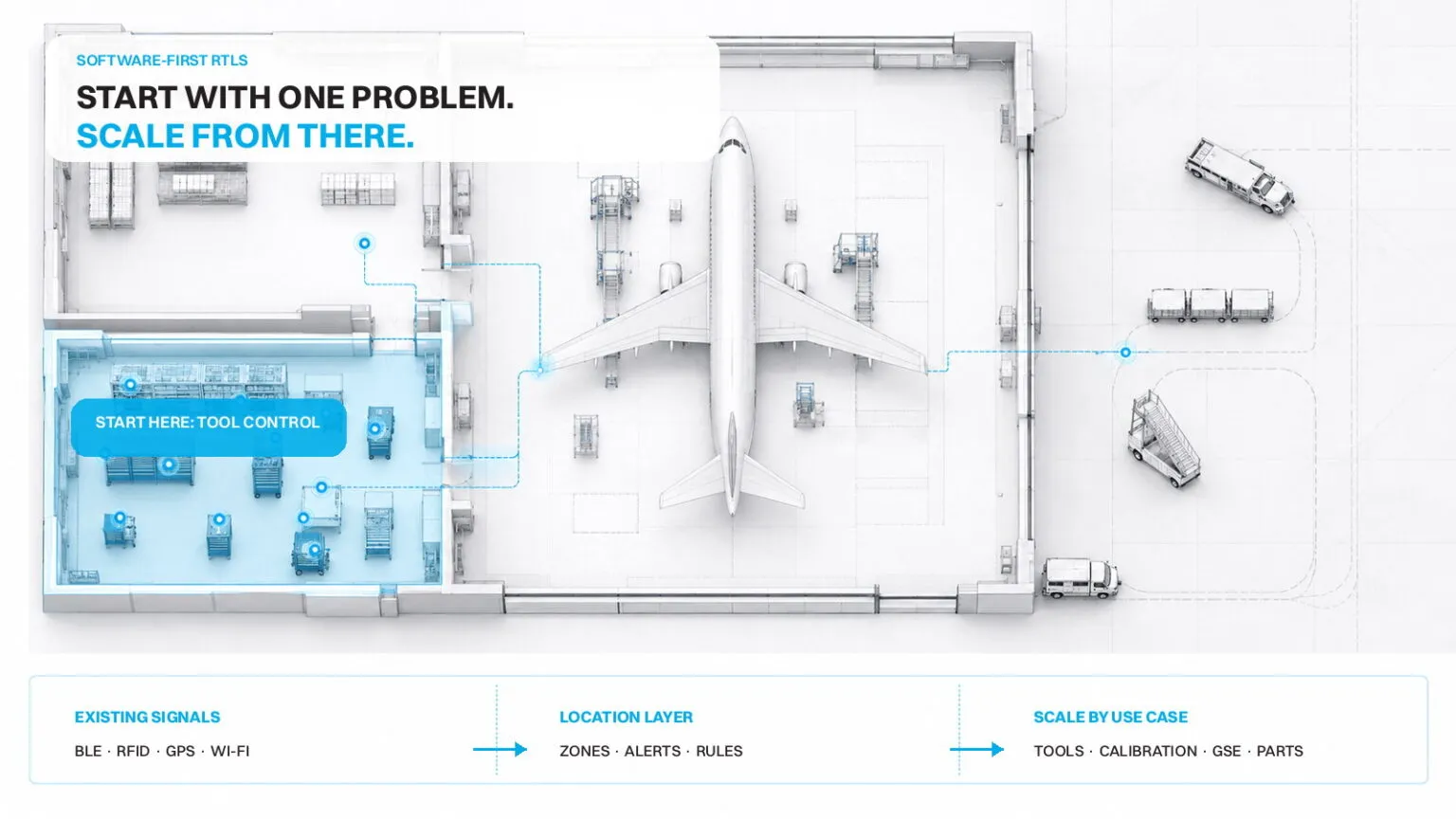
The fastest route to RTLS is a software layer over existing location data, with new wireless infrastructure added only where coverage is missing. A first deployment follows a short, disciplined sequence:
- Map the facility, workflows, assets, and the tracking systems already in use.
- Pick one or two problems that have a measurable baseline.
- Define the location accuracy each decision actually requires.
- Connect existing data sources before installing or replacing working hardware.
- Add battery-powered mesh anchors only where coverage is missing.
- Configure zones, alerts, asset records, and workflow rules.
- Test during normal shifts, compare against the baseline, and extend by use case.
Hangars are difficult radio environments. Aircraft structures, doors, equipment, and people all alter signal paths, so anchor placement and zone boundaries have to be tested in the operating environment rather than assumed. Starting small is not a limitation here; it is the method that keeps the project honest.
IN PARTNERSHIP WITH SYNAPSES
Synapses, through its BlueGPS platform, is an example of the software-first approach in practice. Founded in 2012 and headquartered in Milan, Synapses has delivered indoor-positioning deployments across more than 50 venues in over 7 countries. BlueGPS is built on a microservices architecture that integrates multiple RTLS technologies, BLE, UWB, RFID, and GPS, into a single location layer with facility maps, asset records, workflow rules, and analytics.
For MRO specifically, that design maps to the use cases above: it combines the location signals a shop already generates rather than replacing them, supports battery-powered mesh where no fixed network exists, and matches accuracy to the decision from zone-level presence to precise positioning. It is certified to ISO/IEC 27001 and ISO 22301. The relevance to Aero NextGen’s audience is the deployment model as much as the technology: it is designed to start with a focused problem rather than a facility-wide install.
Why the barrier to entry has fallen:
| 30-60 min Tool search per work order (industry) | ~$4B/yr Direct FOD cost to aviation | ~99% Inventory accuracy with RFID capture |
|---|
“Real-time asset tracking should not require a complex and expensive infrastructure project to deliver value. With flexible hardware and a software-first location platform, an MRO can start with one problem, prove the return, and scale from there. That is what puts location intelligence within reach of the whole market, not just the largest operators.”
– Steven Manifold, Chief Marketing Officer, Synapses
The Aero NextGen take
For years, real-time location was a large-operator capability. The economics have changed, and the operators who were shut out, regional shops, independents, component repair, and specialists, are the ones where recovered hours and controlled assets move the P&L fastest. The right question is no longer whether a shop can afford RTLS. It is which single problem, tool search, calibration control, GSE location, or material availability, is costing the most today, and whether the shop would even know.
“Technology should meet operators where they are. When asset tracking stops being a capital project and becomes a scoped software decision, the mid-market gets access to the same location intelligence the majors have used for years. Aero NextGen exists to match that exact pain point to the providers who can solve it.”
– Monica Badra, Founder & CEO, Aero NextGen
Find your fit in 3 minutes: complete the Solution Finder quiz. Answer a short set of questions and get matched to the providers built for your operation.
Sources
- BlueGPS (Synapses) – A Faster Route to RTLS in Aerospace MRO: software-first RTLS, BLE mesh, tool search, FOD, GSE, technician productivity (July 2026) – www.bluegps.it/blog/a-faster-route-to-rtls-in-aerospace-mro
- Synapses – company profile, BlueGPS platform, deployments across 50+ venues in 7+ countries – synapseslab.com/
- Aviation safety references – FOD estimated at ~$4B/yr direct, up to ~$13B including indirect costs (Boeing/FAA/NAFPI) – skybrary.aero/articles/foreign-object-debris-fod
- Airports Council International – FAA analysis: true FOD cost as high as $22.7B annually including indirect (2025) – airportscouncil.org/2025/04/30/the-silent-airside-threat-how-ai-is-fighting-foreign-object-debris-fod-and-revolutionizing-airport-operations/
- Synapses – Aero NextGen vendor page – www.aero-nextgen.com/vendors/synapses-lab