August 18, 2026 · BlueGPS Team
Aircraft Parts Tracking Across the MRO Process
Learn how aircraft parts tracking connects stores, quarantine, kitting, staging, and point of use to reduce delays and improve MRO visibility.
The maintenance system shows that the part is available.
The technician cannot use it.
It may still be in stores. It may be waiting for inspection, held in quarantine, placed in the wrong kit, moved to another aircraft bay, or left in staging without a status update.
From an inventory point of view, the part exists.
From a maintenance execution point of view, it is missing.
Aircraft parts tracking must connect these two views. The MRO provider needs to know not only whether the part is owned or recorded, but also where it is, what state it is in, which work order requires it, and whether it has reached point of use.
Parts traceability has two meanings
In aviation maintenance, parts traceability often refers to the records that establish a component’s identity, origin, airworthiness status, history, certification, and eligibility for installation.
Those records remain necessary. RTLS does not replace authorized release documents, maintenance records, life records, configuration controls, or airworthiness procedures.
Aircraft parts tracking addresses a related operational question: where is the physical item within the maintenance process?
The system may need to show that a component is:
- Awaiting receipt inspection
- In quarantine
- Released to stores
- Assigned to a work order
- Included in a kit
- Waiting in staging
- Delivered to an aircraft bay
- Removed from an aircraft
- Moving to a repair shop
- Waiting for test or inspection
- Approved for reassembly
- Ready for return to the customer
The airworthiness record explains what the part is and whether it can be used. Location and process data explain where it is and what should happen next.
Inventory availability is not operational readiness
An inventory system may record that a part is on site and available.
The maintenance task requires a higher standard of readiness.
The part must be:
- The correct item.
- In the required condition.
- Released for use.
- Assigned to the correct aircraft or work order.
- Physically present where the task will take place.
- Available at the required time.
A failure at any of these points can delay the task.
This distinction matters during material planning. A planner may see sufficient stock but still lack evidence that the required items have completed inspection, entered the correct kit, and arrived at the bay.
Real-time or event-based location data gives planners a view of physical readiness.
Follow the part through the complete process
Aircraft parts do not move directly from stores to installation.
They may pass through several controlled stages.
Receiving
The site records the incoming shipment and associates each tracked item with its order, supplier, part identity, and receiving process.
Inspection and quarantine
The part moves to inspection or quarantine. Its location should agree with its status. A part recorded as quarantined should not appear in an unrestricted staging or aircraft area.
Storage
Released parts move to the correct store, rack, cage, or controlled environment. Location events can confirm that transfer.
Kitting
The system associates each part with a work package, aircraft, task, or bill of material. A kit should show both its expected contents and the location of those contents.
Staging
The kit or component moves closer to point of use. Long dwell time in staging may indicate an incomplete kit, task delay, or poor material coordination.
Point of use
The part reaches the correct aircraft, bay, engine, or component workstation. The system can record arrival against the work order.
Return, repair, or disposal
Unused, removed, rejected, or repairable items follow a controlled route back to stores, quarantine, repair, scrap, or the supplier.
Location data can confirm whether the physical movement follows the approved process.
Parts shortages make physical visibility more important
IATA has reported that airlines are increasing spare-parts inventory in response to supply uncertainty. It also identifies the need for stronger data visibility and improved traceability across the aviation supply chain.
When supply becomes less predictable, the value of each available component increases.
The MRO provider cannot afford to treat a part as unavailable because nobody can find it. Nor can it rely on a stock record that says a part is ready when it remains in an inspection, storage, or transport process.
Physical visibility does not solve external supply constraints. It helps the organization use the inventory it already has with more control.
RFID and RTLS support different parts-tracking decisions
Aircraft parts tracking can use several identification and location technologies.
Barcodes and QR codes provide low-cost identification but require a person or machine to scan the code.
Passive RFID can identify parts without direct line of sight when they pass within range of a reader. It can support receiving, inventory, stores, portals, and controlled process events.
Airbus has used permanent RFID tags on flyable A350 parts to support lifecycle traceability and automate identification processes.
BLE tags can provide zone-level location for kits, containers, components, and other items that need regular updates.
UWB tags can provide more precise positioning for high-value parts, dense staging areas, repair shops, or workstations where close proximity matters.
GPS can track containers, transport units, or larger assets moving between outside areas and sites.
The right choice depends on the item value, number of parts, required accuracy, movement rate, tag life, environment, and operational decision.
A low-cost passive RFID label may suit large numbers of items passing through stores. A reusable BLE or UWB tag may suit a kit, rotatable component, engine module, or transport frame.
Connect part identity, status, and location
A location point alone does not tell the maintenance team whether a part is usable.
The parts-tracking record should connect:
- Part number
- Serial or batch number
- Description
- Work-order association
- Aircraft or component assignment
- Current location
- Process status
- Inspection or quarantine state
- Kit membership
- Movement history
- Required storage conditions
- Shelf-life or exposure limits
- Expected next operation
This connection allows the system to identify contradictions.
For example:
- A quarantined part enters an aircraft bay.
- A part assigned to Aircraft A moves to Aircraft B.
- An incomplete kit enters staging.
- A component misses an expected inspection route.
- A shelf-life-sensitive material remains outside controlled storage too long.
- A removed component moves to the wrong repair area.
- A serviceable part remains in a return or rejection zone.
These events can trigger an alert or hold rather than relying on someone to notice the error later.
Track kits as process objects
A kit is not only a container of parts. It represents the material readiness of a maintenance task.
The tracking system should show:
- Which parts the kit requires
- Which parts have been added
- Which parts remain missing
- Where the kit is located
- Which work package it supports
- Whether it has reached staging
- Whether it has reached point of use
- How long it has waited at each stage
A kit may move before every item is present. Without a clear readiness state, the maintenance team may receive the container and assume the task can begin.
Connecting the kit record to its component records allows the system to distinguish physical arrival from complete readiness.
Use dwell time to find material-flow delays
Long dwell time often reveals where parts flow has stopped.
A component may wait:
- At goods receipt
- In quarantine
- For inspection
- In a picking area
- In an incomplete kit
- At staging
- Outside a repair station
- At a test bench
- For collection after task completion
These delays may not be caused by the part itself. They may indicate missing documentation, inspection capacity, transport availability, poor scheduling, or a delayed work package.
RTLS gives managers data about the location and duration of the wait. That information can support process review and planning.
How BlueGPS supports aircraft parts tracking
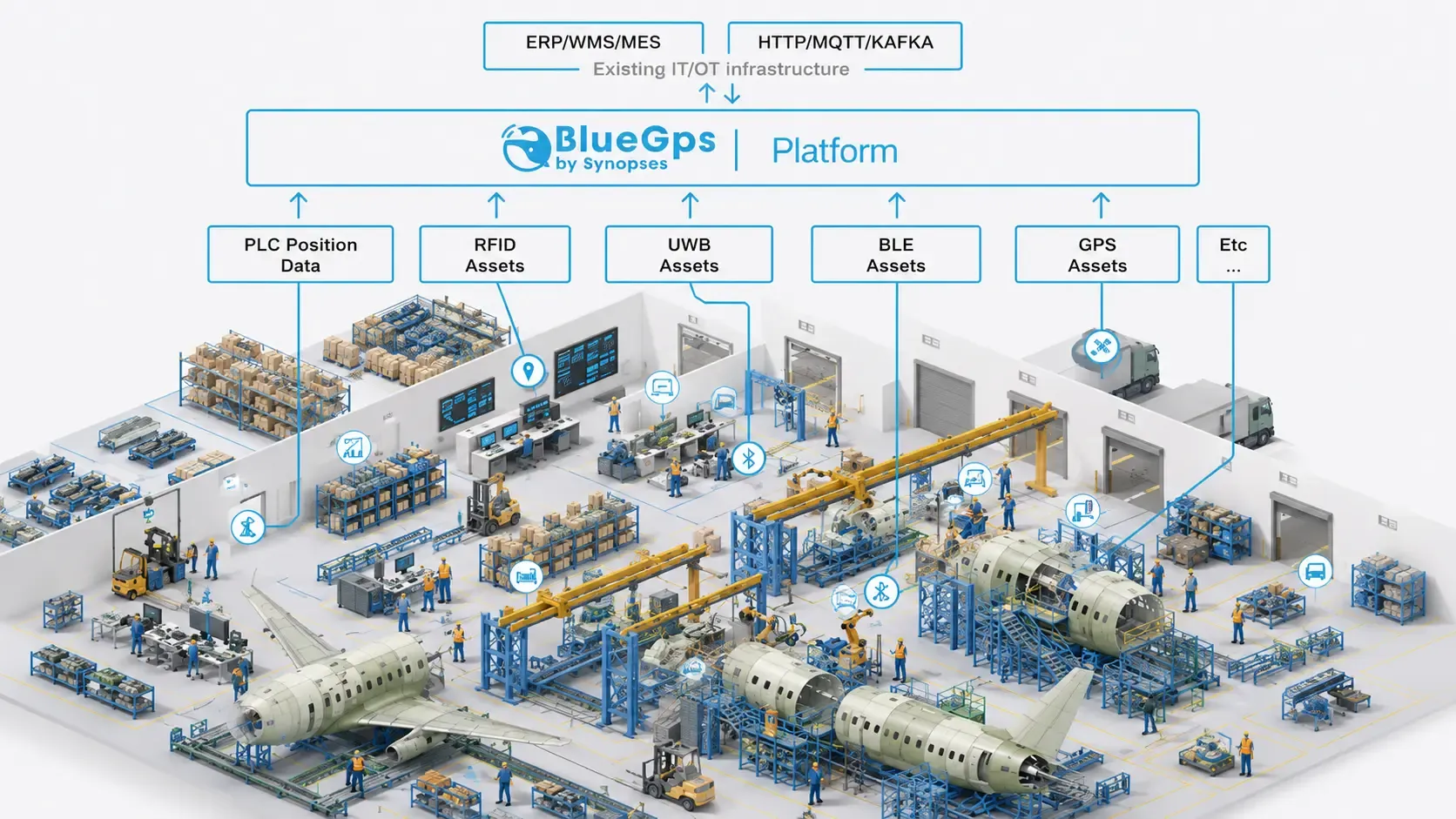
BlueGPS can monitor material movement from storage to point of use and connect part movement with the work order that requires or consumes it.
The platform supports tools including:
- Real-time and last-known part location
- RFID and barcode process events
- BLE (or UWB) tracking
- Indoor and outdoor location
- Part-to-work-order association
- Kit and material-flow visibility
- Quarantine and restricted-zone controls
- Dwell-time analysis
- Exposure-time tracking
- Movement history
- Location-based alerts
- Integration through APIs and SDKs
BlueGPS can also track disassembled components through inspection, repair, testing, and reassembly. Time-stamped location records help confirm where each component has moved and which process step should follow.
Because BlueGPS supports multiple positioning technologies, an MRO provider does not need to apply a high-cost active tag to every part. Passive identification, zone-level tracking, and precise positioning can operate within one location platform.
Track physical readiness, not only inventory
The maintenance team does not need to know only that a part exists.
It needs to know that the part has reached the correct state, location, aircraft, and work package at the right time.
Aircraft parts tracking gives the MRO provider that physical execution view.
BlueGPS connects part identity and location to stores, quarantine, kitting, staging, repair, and point-of-use processes. This helps teams find missing items earlier, identify delayed material flow, and prevent a stock record from creating false confidence.
Request a BlueGPS demo to see how real-time parts and material tracking can connect your inventory data with activity across the hangar.