September 22, 2026 · BlueGPS Team
The Satellite Production Plan Is Only Useful If It Reflects Reality
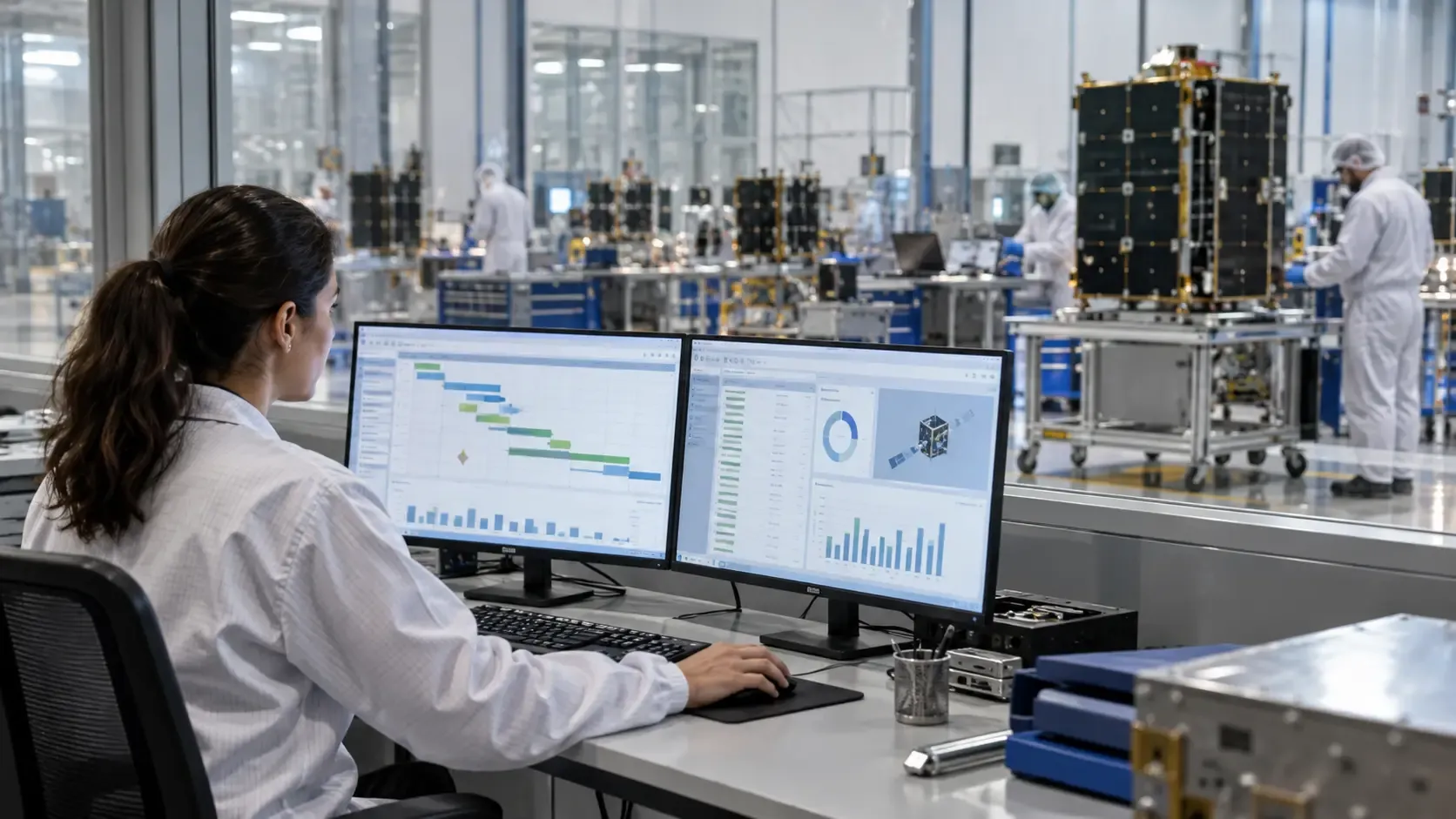
Satellite production schedules depend on accurate information about what is actually happening on the factory floor. RTLS connects physical movement with MES, ERP, PLM, QMS, suppliers, and program teams to provide a more current view of production progress.
As satellite manufacturing scales, the disconnect between planning systems and what is physically happening in production can widen.
A planning system might say that an assembly is ready for integration. But where is it? Has it left inspection? Has the component kit arrived? Is the required fixture available? Is the test facility running to schedule?
These questions become harder to answer as production volumes increase.
The gap between planned and actual production
Traditional production systems rely on transactions. Someone completes an operation, scans an item, changes a status, or confirms that material has moved.
That creates a digital record provided the update occurs and is recorded correctly. That can add time and complexity with extra steps in a production process that is ramping up. It can also introduce errors, meaning the digital record and the physical reality can drift apart.
BlueGPS addresses this by using location events to connect physical movement with manufacturing systems. A component moving from controlled storage into staging, for example, can become a digital event rather than waiting for someone to update its location manually.
This creates a more current picture of production.
Know when the schedule starts to slip
Most schedule problems begin with small events. A subsystem spends two days longer in inspection. A satellite waits outside a vibration-test area when it is actually clear and ready for use. A component kit reaches production several hours late. A shared fixture remains at another workstation.
Individually, these events appear minor, but as production scales, across several spacecraft and hundreds of operations, they accumulate.
RTLS can measure movement and dwell time as production takes place. Manufacturers can compare those events with the expected process and identify when actual execution begins to diverge from the plan.
That gives teams time to respond before a small delay becomes a program-level problem.
Extend visibility beyond the factory floor
The same approach can improve coordination with suppliers.
A supplier may confirm that a component has shipped. Logistics data may show that it has arrived at the facility. RTLS can continue that chain of visibility once the part enters the plant.
Has it reached goods-in? Has inspection released it? Is it in controlled storage? Has it reached staging? Is it physically at the integration station?
Each step brings the digital schedule closer to physical reality.
That information can also support communication with customers.
Instead of relying only on planned milestones, program teams can use current execution data to understand the status of spacecraft moving through production and test.
Create one view of execution
RTLS does not replace ERP, MES, PLM, QMS, supplier portals, or customer systems.
Its role is to provide something those systems often lack: continuous information about the physical location and movement of products and resources.
That data can update systems of record, trigger workflows, identify exceptions, and provide a common view of execution.
For satellite manufacturers, that becomes increasingly important as production scales.
A schedule tells you where a spacecraft should be.
Real-time production visibility tells you whether it is actually there, whether everything it needs has arrived, and whether the next milestone is still achievable.