September 15, 2026 · BlueGPS Team
Scaling Satellite Production: From Project Manufacturing to Repeatable Production
Satellite manufacturers are moving from low-volume, project-based production toward repeatable manufacturing at scale. See how RTLS can improve production flow, reduce delays, support Just-in-Line material delivery, and expose the bottlenecks that limit output.
For much of the industry’s history, manufacturers built satellites as individual projects. Production volumes were low, schedules were measured in years, and teams could manage much of the process through project meetings, engineering knowledge, and manual coordination.
Constellations change that model.
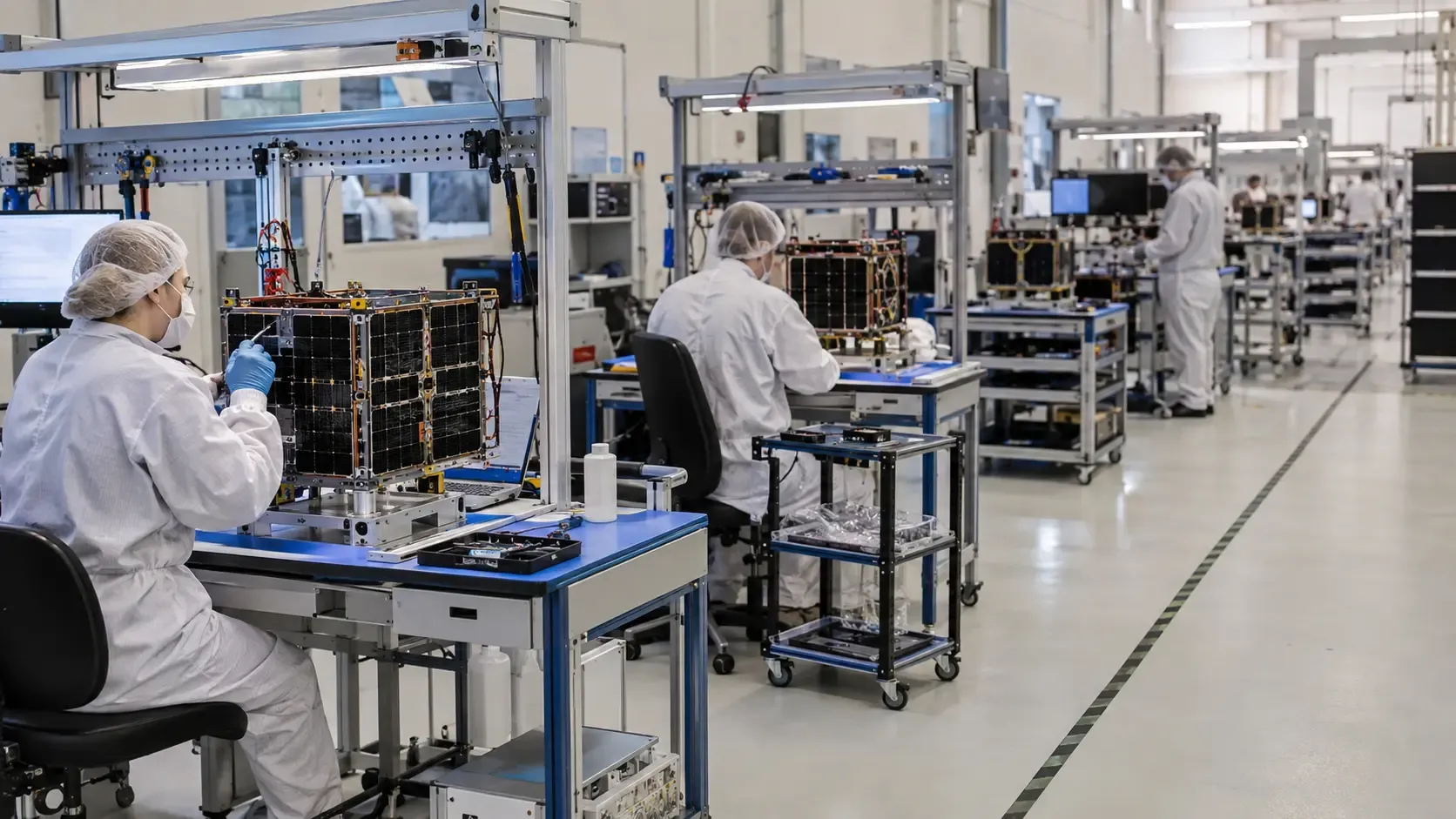
Manufacturers increasingly need to build tens or hundreds of spacecraft using the same production system. Airbus, for example, is now producing new batches of OneWeb satellites from a serial production facility in Toulouse, with hundreds of additional spacecraft on order.
The challenge is turning a process designed around individual spacecraft into a repeatable manufacturing operation.
Small delays become production problems
When production volume increases, problems that were manageable on one spacecraft start to affect the whole line.
A component arrives late. A fixture is being used by another team. A satellite waits outside a test area. A technician cannot find the required tool. A thermal-vacuum chamber finishes one test, but the next spacecraft is not ready.
With one spacecraft, teams may be able to work around these problems.
With 20 spacecraft moving through Assembly, Integration and Test at the same time, the same problems create queues, disrupt sequencing, and reduce output.
This is where real-time location systems, or RTLS, can provide another layer of production data.
See how production actually moves
MES and ERP platforms tell manufacturers what should happen. RTLS helps show what is happening physically.
By tracking spacecraft, subassemblies, component kits, tools, fixtures, test equipment, and other resources, manufacturers can see how work moves through production.
That creates data about more than location.
How long did an assembly wait between operations? Where is work-in-progress accumulating? How often is a test fixture being used? How much time passes between one satellite leaving a workstation and the next one arriving?
These measurements make physical production flow visible.
Manufacturers can then identify whether a constraint comes from lack of capacity or from the way existing capacity is being used.
Support Just-in-Line production
Higher-volume production also changes material logistics.
Components cannot simply arrive somewhere within the factory. They need to reach the correct workstation in the correct sequence and at the correct time.
RTLS can track kits and components from stores through staging and into production. Location events can then connect with MES, ERP, or WMS processes.
Instead of discovering that a required component is missing when an operator is ready to install it, the production system can identify the problem earlier.
The same principle applies to tools, fixtures, and test equipment.
Scale the process, not just the workforce
Moving from ten satellites a year to 100 is not achieved by putting ten times as many people into the same process.
Manufacturers need to remove waiting, searching, unnecessary movement, poor sequencing, and hidden bottlenecks.
RTLS can provide the physical production data needed to understand how the factory operates, where capacity is being lost, and what needs to change before higher production rates become sustainable.
That becomes more important with every additional spacecraft moving through the line.