September 17, 2026 · BlueGPS Team
Satellite Reliability Starts on the Production Floor
Satellite reliability depends on thousands of manufacturing and test operations being completed correctly. RTLS adds location-based verification to help confirm that the correct people, tools, parts, and equipment are present during critical production steps.
A manufacturing error in many industries can result in a repair, warranty claim, or product recall. For a satellite already in orbit, those options don’t really exist.
Reliability therefore starts long before launch. It depends on completing thousands of manufacturing, assembly, integration, inspection, and test operations as required.
The challenge becomes harder as production increases; a process that works when a small team builds a few spacecraft each year may become difficult to control when several satellites move through production at the same time.
Manufacturers need to increase throughput without weakening the controls that protect product quality.
Verification matters as much as speed
Satellite manufacturing already relies on procedures, quality systems, inspection records, and test results.
NASA quality requirements, for example, emphasize traceability between manufacturing and test procedures, individual hardware items, serial or lot numbers, operators, and the production flow.
But there is another question behind those records:
- What physically happened?
- Was the correct tool used on the correct assembly?
- Was the required component present?
- Was the person performing the operation qualified to do it?
- Did the assembly pass through the required inspection or test area?
Real-time location systems can provide another source of evidence.
Verify the conditions around an operation
RTLS does more than place a dot on a map. A location platform can define production zones and monitor which tagged assets and people are present inside them.
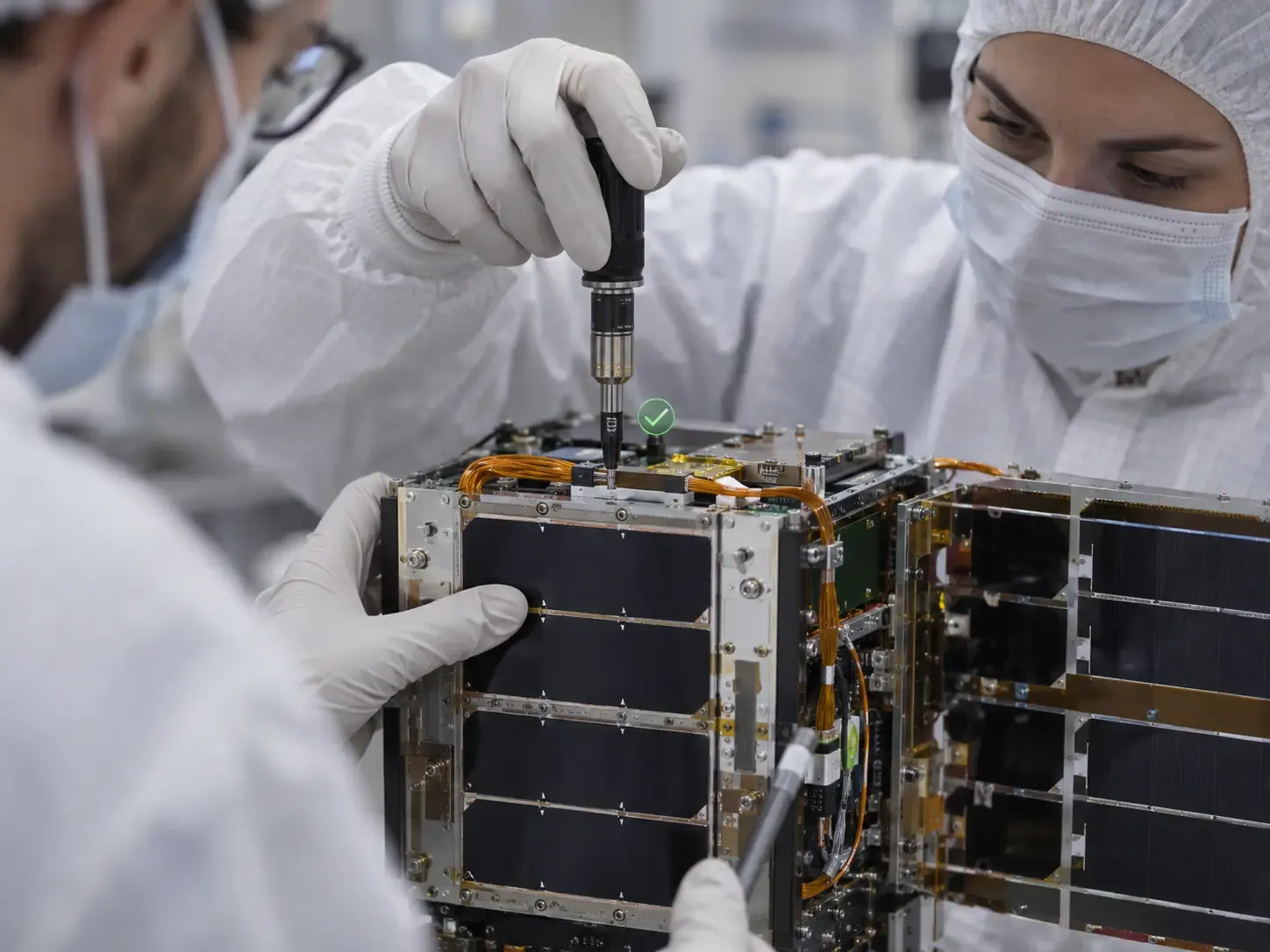
The manufacturing process may require spacecraft bus number 12, a specified component, a calibrated torque tool, and an operator with the required qualification to be present at workstation six.
BlueGPS can determine whether those items were physically co-located during the operation.
That does not replace an MES, QMS, calibration system, or electronic work instruction. It adds location evidence to those systems.
If the wrong tool enters the work area, a rule can generate an exception. If a required fixture has not arrived, the process can be held before work starts. If an assembly moves to the next stage without entering a required inspection zone, the system can identify the deviation.
Build the production history automatically
Location also creates a history. Manufacturers can record when a component entered a work area, how long it stayed there, which tools were nearby, and which tagged personnel were present.
This becomes useful when investigating a later problem. Instead of reconstructing events from memory, spreadsheets, and separate system records, quality teams can add physical movement and co-location data to the investigation.
The same data can help identify other products that passed through the same workstation, interacted with the same resource, or followed the same process.
Reliability and scale do not have to conflict
Increasing satellite output introduces more products, more movements, more handoffs, and more opportunities for variation.
The answer cannot be to add more manual checks at every step. That would eventually limit throughput.
Instead, manufacturers need controls that operate as part of the production process.
RTLS can automate part of that verification by turning location, movement, and co-location into production events.
The result is not simply better tracking.
It is another way to make sure that as the factory moves faster, the process continues to happen as intended.